Wired for the Future: How Joe Zawinul Turned Synthesizers Into Jazz's Most Powerful Voice
There is a particular moment on Weather Report's 1977 album Heavy Weather — roughly two minutes into "Birdland" — when the synthesizer swells so organically, so convincingly alive, that listeners who encounter it for the first time often struggle to identify what they are actually hearing. Is it a string section? A choir? Something altogether new? The answer, of course, is that it is all of those things and none of them. It is Joe Zawinul, commanding a bank of keyboards with the authority of a composer who understood, well ahead of his peers, that electronic sound was not a novelty to be tolerated but a language to be mastered.
Weather Report's keyboard innovations represent one of the most consequential technological leaps in American music history. To fully appreciate what the band accomplished, it is necessary to understand both the musical landscape they inherited and the extraordinary lengths to which Zawinul went to reshape it.
The Landscape Before the Revolution
When Weather Report formed in 1970 — with Zawinul and saxophonist Wayne Shorter at the creative center — jazz was navigating a profound identity crisis. The acoustic traditions established by Miles Davis, John Coltrane, and Thelonious Monk remained sacred to purists, while a younger generation of musicians felt constrained by those very conventions. The electric experiments of Davis's Bitches Brew (on which Zawinul himself played) had demonstrated that jazz could absorb rock energy and electronic texture without forfeiting its improvisational soul. Weather Report took that opening and drove a freight train through it.
Zawinul arrived at the band already fluent in the Fender Rhodes electric piano, an instrument he had helped popularize through his work with Davis. But his ambitions extended far beyond the Rhodes's warm, bell-like tones. He recognized early that synthesizers — then enormous, temperamental, and frequently unpredictable machines — offered something the acoustic world simply could not: the ability to sculpt sound itself, to invent timbres that had never previously existed.
From Fender Rhodes to Polymoog: Building a New Vocabulary
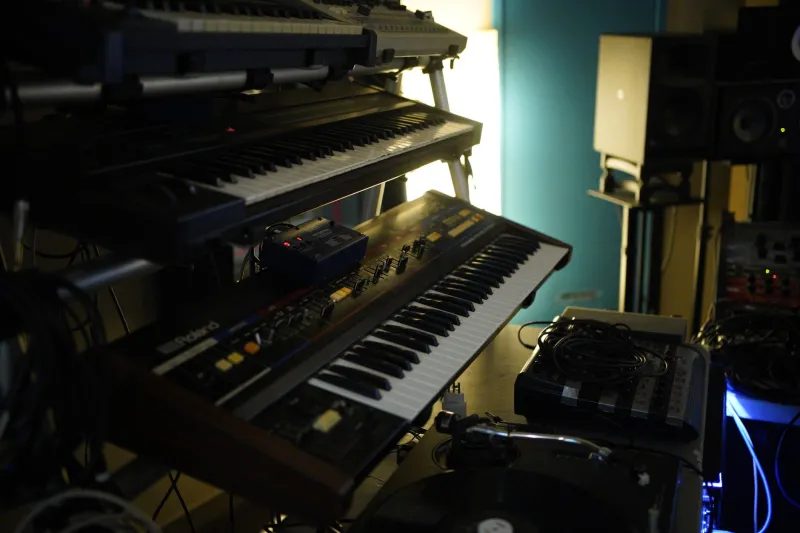
The evolution of Zawinul's keyboard setup across Weather Report's catalog reads almost like a technology timeline. On early recordings such as Mysterious Traveller (1974), he layered electric pianos with early synthesizer textures, creating atmospheric passages that felt simultaneously ancient and futuristic. The ARP 2600, a semi-modular synthesizer capable of extraordinary sonic manipulation, became a central tool in his arsenal during this period. Zawinul treated it not as a gimmick but as a genuine compositional instrument, using it to replicate orchestral colors, environmental sounds, and entirely imaginary timbres.
By the time Tale Spinnin' arrived in 1975, Zawinul had expanded his setup to include the Oberheim polyphonic synthesizer and the Fender Rhodes in configurations that allowed him to layer sounds with unprecedented density. Critics at the time occasionally struggled to describe what they were hearing — the vocabulary of electronic music criticism had not yet caught up to the reality of what Weather Report was producing.
The Polymoog synthesizer, introduced into Zawinul's rig around the Black Market era (1976), added yet another dimension: a lush, almost vocal quality that he deployed with remarkable restraint. Where other musicians of the period used synthesizers to signal modernity, Zawinul used them to communicate emotion. The distinction is not trivial. It is the reason Weather Report's recordings have aged with such grace while so many of their contemporaries now sound dated.
"Birdland" and the Synthesis of Everything
No single track better illustrates Zawinul's keyboard philosophy than "Birdland," the opening statement of Heavy Weather. Written as a tribute to the legendary New York jazz club of the same name, the composition required Zawinul to evoke both the grandeur of a live jazz performance and the intimacy of personal memory. His solution was characteristically sophisticated: he constructed the track's main melody using synthesizer patches that mimicked the harmonic richness of a brass section, then surrounded them with Rhodes voicings that grounded the whole arrangement in recognizable jazz tradition.
The result was a piece that felt simultaneously nostalgic and radical — a quality that defined Weather Report at their peak. "Birdland" became the band's most commercially successful recording, reaching audiences far beyond the jazz world and introducing millions of American listeners to the possibilities of fusion. Its keyboard arrangements remain studied in music production programs across the country to this day.
The Organic-Electronic Balance That Still Mystifies Producers
What separates Zawinul's approach from the synthesizer experimentation of his contemporaries — and from much of what followed in the decades since — is his insistence on emotional authenticity. He was not interested in demonstrating what synthesizers could do in an abstract sense. He was interested in what they could feel like.
This meant developing an intimate understanding of synthesis parameters — envelope shaping, filter cutoff, modulation depth — not as technical specifications but as expressive tools analogous to a horn player's embouchure or a pianist's touch. He adjusted attack times to create the impression of breath. He used filter sweeps to simulate the natural resonance of acoustic spaces. He blended electronic and acoustic sources so seamlessly that the seam between them became effectively invisible.
Modern producers working in genres from neo-soul to ambient electronic music continue to study this approach because it solved a problem that has never entirely disappeared: how to make electronic instruments feel human without sacrificing their unique capabilities. Zawinul's answer — essentially, to treat the synthesizer as an extension of the performer's body rather than a separate machine — remains as instructive now as it was in 1977.
A Legacy Written in Circuits
The influence of Weather Report's keyboard innovations can be traced through an extraordinarily diverse lineage of American music. Herbie Hancock, already a master of electric keyboards himself, has cited Zawinul's synthesis work as a formative influence on his own electronic explorations. The jazz-funk productions of the 1980s owe a structural debt to the rhythmic keyboard layering Weather Report pioneered. Contemporary artists working at the intersection of jazz and electronic music — from Thundercat to Robert Glasper — operate in a sonic space that Zawinul helped define.
Perhaps most significantly, Weather Report demonstrated that technological innovation and musical depth are not mutually exclusive — a lesson that remains urgently relevant in an era when music production tools are more accessible than ever. Zawinul did not use synthesizers because they were fashionable. He used them because they allowed him to say things that no other instrument could express. That distinction, between novelty and necessity, is what separates a trend from a revolution.
The synthesizer revolution that Weather Report ignited in the 1970s was never really about the machines. It was about what a musician of extraordinary vision could do when given access to an entirely new palette. In Zawinul's hands, those circuits and oscillators became something very close to a new instrument — one that jazz had never heard before and has never entirely stopped playing since.