The Uncredited Architecture: Recovering the Women Who Built Weather Report's Sound
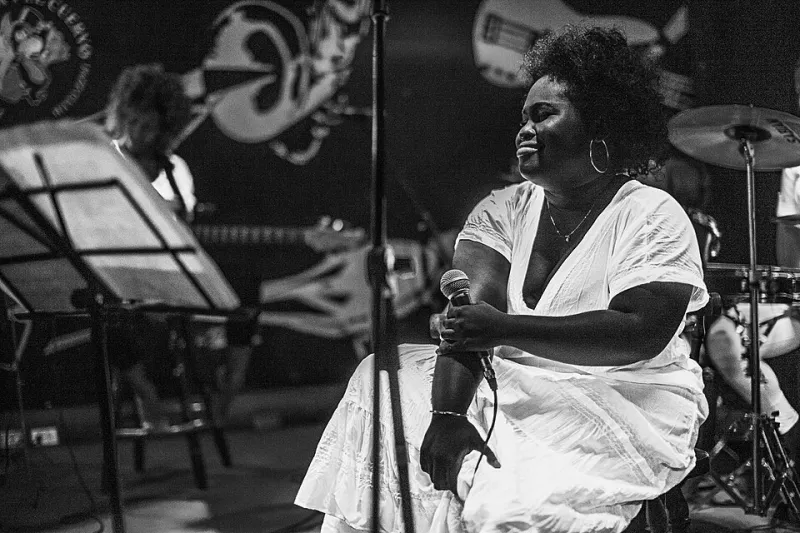
Photo: Don Azevedo, CC BY-SA 4.0, via Wikimedia Commons
Every canonical history is also, by definition, a record of what was left out. The history of Weather Report — as it has been written in liner notes, music journalism, and the academic literature on jazz fusion — is a history organized around a small number of named men. Josef Zawinul. Wayne Shorter. Jaco Pastorius. Alphonse Mouzon. Miroslav Vitouš. These names appear with regularity, are analyzed with depth, and are credited with the creative decisions that shaped the band's legacy. The women who moved through the same creative orbit receive, at most, a parenthetical acknowledgment.
This is not a minor oversight. It is a structural distortion that has produced a misrepresentation of how the music was actually made — who contributed to it, who shaped the environments in which it developed, and whose aesthetic sensibilities left marks on a catalog that continues to influence musicians working today. Correcting that distortion is not a project of revisionist sentiment. It is a project of historical recovery.
What Standard Histories Choose to See
The critical literature on Weather Report was largely produced by a generation of jazz journalists for whom the dominant frameworks of musical evaluation were built around individual male genius. This was not a Weather Report-specific problem. It was a systemic feature of how jazz criticism operated throughout the 1970s and 1980s, a period during which the contributions of women to musical production were routinely filtered out by the assumptions embedded in the questions critics thought to ask.
The questions critics asked about Weather Report were questions about compositional authorship, instrumental virtuosity, and conceptual vision — all understood as properties of the named bandleaders. The questions they did not ask were questions about the social and collaborative infrastructure that sustained the band's creative work: who managed the interpersonal dynamics that allowed Zawinul and Shorter's famously contentious partnership to remain productive, who shaped the sonic environments of the recording sessions, who provided the cultural and aesthetic feedback that informed compositional decisions.
These are not soft questions. They are questions about real creative labor, and the answers to them involve women whose names do not appear in the standard accounts.
The Studio as a Gendered Space
The recording studio, in the era when Weather Report produced their most significant work, was an environment shaped by deeply entrenched gender norms. Engineering was understood as a technical and therefore masculine domain. Production was understood as an executive and therefore masculine function. The women who worked in and around recording studios during this period did so against significant structural resistance, and their contributions were frequently absorbed into the credited work of male colleagues without acknowledgment.
This pattern is not speculative. It has been documented extensively in the broader history of popular music production, and there is no reason to believe that the sessions that produced Weather Report's catalog were exempt from it. The engineers who assisted on those sessions, who managed tape operations, who contributed to the sonic decisions that shaped the recorded sound — these individuals existed, and some of them were women. The absence of their names from the historical record reflects the conventions of the time, not the reality of their presence.
Recovering those names requires the kind of archival work that the jazz scholarship community has not yet systematically undertaken for Weather Report's catalog. Session logs, studio booking records, and the personal archives of musicians and producers who worked adjacent to the band represent a documentary record that remains largely unexamined. The work of recovery is possible. It has simply not been prioritized.
Musicians at the Margins of the Frame
Beyond the studio, there is the question of the musicians whose playing influenced the band's development without receiving formal credit. Weather Report operated within a broader ecosystem of jazz and fusion musicians in cities including New York, Los Angeles, and Vienna — cities where Zawinul and Shorter maintained relationships with a wide range of performers. Female musicians were part of that ecosystem, and their musical ideas circulated through the informal channels — rehearsal rooms, after-hours sessions, social gatherings — through which musical influence actually travels.
The challenge in documenting this kind of influence is that it leaves limited archival traces. Formal recording credits are the primary evidentiary tool that music historians work with, and those credits systematically underrepresent contributions made outside the formal studio context. But the absence of documentary evidence is not evidence of absence, and the assumption that Weather Report's creative development occurred in a hermetically sealed masculine environment is an assumption that the evidence does not support.
Shorter, whose compositional sensibility was shaped by an unusually wide range of cultural and aesthetic influences, has spoken in interviews about the importance of conversations with musicians across genres and backgrounds to his creative process. That those conversations included women is a reasonable inference. That those women's contributions to his thinking went unacknowledged in the formal record is consistent with the patterns that characterized the era.
The Critics Who Were Never in the Room
Fusion criticism's gendered blind spots were not limited to the erasure of female contributors. They extended to the evaluative frameworks that critics applied to the music itself. The qualities that jazz criticism valorized in this period — technical virtuosity, harmonic complexity, structural ambition — were qualities coded as masculine within the cultural assumptions of the time. Qualities associated with collaborative sensibility, textural nuance, and emotional accessibility were correspondingly devalued.
This meant that aspects of Weather Report's music that were, in fact, among its most sophisticated achievements — the sensitivity of ensemble interaction, the care with which individual voices were balanced within the collective texture, the emotional intelligence embedded in compositional choices — received less critical attention than the more legible markers of virtuosity. And it meant that the contributors whose influence was most visible in those qualities were the contributors least likely to be credited.
A criticism capable of seeing the full architecture of Weather Report's achievement would need to ask different questions than the ones the existing literature has asked. It would need to treat collaboration as a form of creative authorship, to recognize textural and sonic intelligence as equivalent in value to compositional and improvisational intelligence, and to be willing to follow the evidence of influence wherever it leads — including toward contributors whose names have not yet appeared in the standard accounts.
Why This Matters Now
The argument for recovering Weather Report's uncredited contributors is sometimes framed as a matter of social justice — a corrective to historical inequity. That framing is not wrong, but it is incomplete. The more compelling argument is that the existing history is, by virtue of its omissions, an inaccurate account of how the music was made. And an inaccurate account of how great music was made is a disservice not only to the people whose contributions it erases but to the musicians and listeners who might learn from a more complete picture.
Weather Report's achievement was not the product of two men working in isolation. It was the product of an extended creative community operating across decades, cities, and contexts. The women who were part of that community helped build something that endures. Their names belong in the record. The work of putting them there is overdue.