Order from Disorder: The Scientific Logic Embedded in Weather Report's Compositional Method

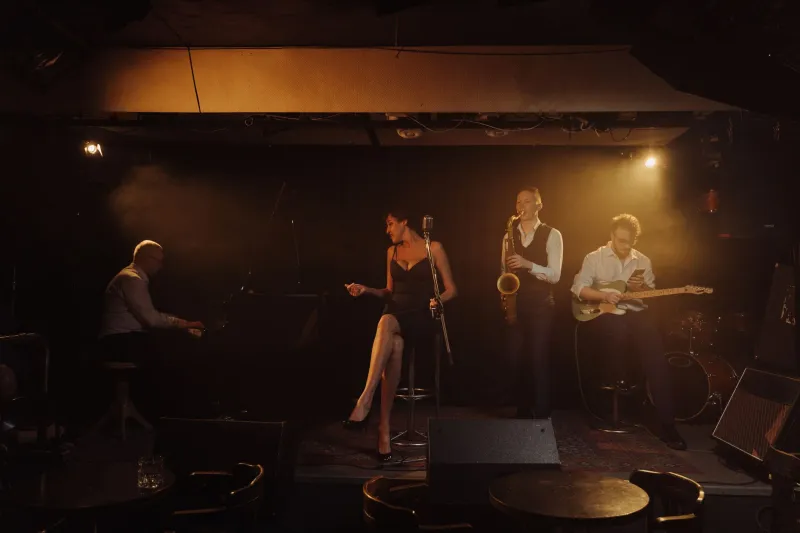
Photo by Photo by Logan Voss on Unsplash on Unsplash
Chaos, in the scientific sense, is not the absence of order. It is the presence of an order so complex that its patterns resist immediate recognition. This distinction — between apparent randomness and genuine systemic complexity — sits at the heart of chaos theory, a branch of mathematics that emerged as a formal discipline in the latter half of the twentieth century. It also sits, perhaps less formally but no less meaningfully, at the heart of Weather Report's compositional philosophy.
The parallel is not merely metaphorical. An honest examination of how Josef Zawinul and Wayne Shorter structured their music — how they organized rhythm, harmony, texture, and form — reveals a set of principles that align with remarkable precision to concepts that mathematicians and physicists were simultaneously developing in their own laboratories. The band was not reading academic papers on dynamical systems. But they were, intuitively and rigorously, solving similar problems.
Sensitive Dependence and the Compositional Environment
One of the foundational concepts in chaos theory is sensitive dependence on initial conditions — the principle, popularly illustrated by the butterfly effect, that small variations in a system's starting state can produce dramatically different outcomes over time. In musical terms, this principle manifests whenever a composition's trajectory is shaped by the specific conditions of its performance: the acoustic properties of the room, the energy of the ensemble on a given night, the micro-decisions that individual musicians make in real time.
Weather Report built this sensitivity into their compositions deliberately. Zawinul was famously resistant to what he called the tyranny of the written note — the idea that a score represented a fixed destination rather than a set of initial conditions. Many of the band's compositions functioned less as instructions than as environments: defined enough to provide coherent structure, open enough to respond to the variables that live performance introduces.
This is not jazz improvisation in the conventional sense. Traditional jazz improvisation operates within harmonic frameworks — chord changes, scales, forms — that constrain the possibilities without determining the outcome. Weather Report's approach was more systemic. The entire ensemble was participating in a real-time negotiation with the composition's possibilities, and the outcomes that emerged were not improvisations layered onto a fixed structure but transformations of the structure itself.
Emergence and the Ensemble as Complex System
Emergence is the property by which complex systems produce behaviors that cannot be predicted from, or reduced to, the properties of their individual components. A flock of birds exhibits coherent collective movement that no individual bird coordinates or controls. A colony of ants constructs architecturally sophisticated structures without any centralized planning. Emergence is what happens when local interactions produce global patterns.
Weather Report's ensemble functioned as an emergent system in precisely this sense. Zawinul has described rehearsal processes in which musicians were given thematic material and rhythmic parameters but were expected to find their own relationship to the compositional space. The music that resulted was not the sum of individual contributions. It was something that arose from the interaction of those contributions — a collective behavior that transcended what any single player could have generated alone.
This is audible in recordings across the band's catalog. On Mysterious Traveller, the interplay between Zawinul's synthesizer layers and Alphonse Mouzon's percussion creates rhythmic patterns that neither instrument is producing independently. On Black Market, the bass and keyboard lines generate harmonic tensions that resolve in ways the individual parts do not anticipate. The music thinks, in a sense — it produces solutions to problems that were never explicitly posed.
Controlled Unpredictability and Experimental Music Traditions
Weather Report did not develop their approach to compositional complexity in isolation. They were working within, and in dialogue with, a tradition of experimental music that had been interrogating the relationship between structure and indeterminacy since at least the 1950s.
John Cage's aleatory compositions, which incorporated chance operations and performer choice as structural elements, had established a vocabulary for thinking about music in which outcomes were not fully determined by compositional decisions. Karlheinz Stockhausen's concept of moment form — in which a composition is organized as a series of relatively self-contained segments whose order can vary — offered a structural model that Weather Report's more episodic compositions clearly engaged with, whether consciously or not.
Shorter, whose compositional instincts were shaped by a deep engagement with twentieth-century classical music, was particularly attuned to these traditions. His compositions for Weather Report frequently employ what might be described as compositional attractors — recurring melodic or harmonic elements that the music orbits without settling into, generating a sense of ongoing motion toward a resolution that perpetually defers. This is not a jazz technique. It is a technique borrowed from the experimental classical tradition and redeployed within an ensemble context that jazz provided.
Fractal Structure and Self-Similarity Across Scale
Fractal geometry, another product of the late-twentieth-century mathematical revolution, describes structures that exhibit self-similarity across different scales of observation — patterns that repeat at the micro level, the macro level, and every level in between. The coastline of Maine looks irregular whether you observe it from a satellite or trace it on foot. The branching patterns of a tree repeat from the trunk to the smallest twig.
Weather Report's compositions frequently exhibit an analogous property. The rhythmic patterns that govern individual measures often mirror the structural patterns that govern entire compositions. A melodic gesture introduced in the opening bars of a piece will recur, transformed but recognizable, at the compositional level — as a structural division, a harmonic arrival, a textural shift. The music is self-similar in the fractal sense: its local behavior and its global behavior share a common logic.
This quality is part of what makes Weather Report's music so rewarding to close listeners and so difficult to analyze through conventional formal methods. Standard music theory provides tools for describing harmonic function, voice leading, and phrase structure. It does not provide tools for describing the kind of multi-scalar self-similarity that fractal geometry identifies. The music requires a different analytical vocabulary — one that experimental music theory and cognitive musicology are only beginning to develop.
Generative and Adaptive Composition: The Contemporary Inheritance
The compositional principles that Weather Report employed intuitively are now being formalized and extended by practitioners of generative and adaptive music — a field that sits at the intersection of computer science, music theory, and cognitive psychology. Generative composition systems use algorithmic rules to produce music that is structurally coherent but not fully predetermined. Adaptive systems modify musical output in response to real-time environmental inputs, including listener behavior, acoustic conditions, and performer choices.
Both of these approaches are direct descendants of the experimental music traditions that Weather Report engaged with and, in their own way, advanced. The band demonstrated, empirically and through sustained artistic practice, that controlled unpredictability — complexity without randomness, openness without formlessness — was not a compositional liability but a source of musical richness that conventional structures could not produce.
The scientists eventually developed the mathematics to describe what the musicians had already built. That sequence of events — intuition preceding formalization, artistic practice anticipating theoretical understanding — is itself a pattern worth recognizing. Weather Report was not working in a laboratory. But they were conducting experiments, and the results remain instructive.