Plugged In and Unrepentant: Joe Zawinul's Crusade to Make the Synthesizer a Jazz Instrument
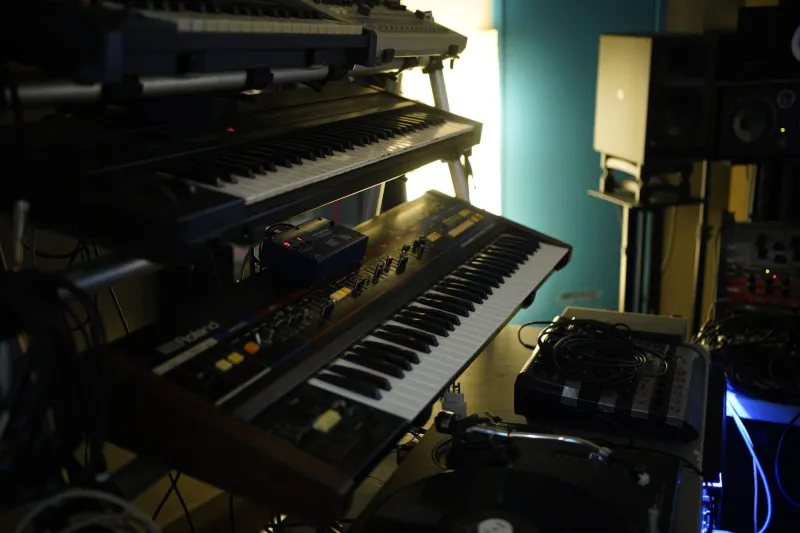
There is a particular kind of courage required to stand in front of an audience of jazz purists, play a Fender Rhodes or an ARP 2600, and declare — without irony, without qualification — that what you are doing is not a departure from the tradition but its logical continuation. Joe Zawinul possessed that courage in abundance. More than any other figure in the music's history, he transformed the synthesizer from a novelty into a necessity, and he did so not by accident but through sustained, deliberate argument.
The story of how Zawinul accomplished this is inseparable from the story of Weather Report itself. But it is also a story about ideas — about what jazz is supposed to be, who gets to decide, and what happens when someone refuses to accept the consensus.
The Acoustic Orthodoxy and Its Discontents
By the late 1960s, jazz carried with it a set of almost theological assumptions about instrumentation. The piano was acceptable. The upright bass was essential. Electric guitars occupied an uneasy middle ground. Synthesizers, with their oscillators and patch cables and distinctly un-human timbres, were viewed by many serious critics and musicians as the province of science fiction soundtracks and novelty records — not vehicles for genuine expression.
Zawinul, who had spent years playing acoustic piano alongside Cannonball Adderley and absorbing the harmonic sophistication of Miles Davis's inner circle, understood this orthodoxy from the inside. He had earned his credentials in the most traditional sense. That background, paradoxically, gave him both the authority to challenge the orthodoxy and a deep understanding of precisely what he was challenging.
His earliest public arguments were practical ones. He pointed out, with characteristic directness, that jazz had never been static in its relationship with technology. The amplification of the upright bass, the adoption of the electric guitar by Charlie Christian, the development of the modern drum kit — each had been greeted with suspicion and eventually absorbed into the tradition. Why should the synthesizer be different?
Sound as Philosophy
What distinguished Zawinul's position from simple pragmatism, however, was the philosophical dimension he attached to it. He was not merely arguing that synthesizers were useful. He was arguing that they were expressive — that they could carry emotional weight, cultural memory, and musical intelligence in ways that acoustic instruments could not always replicate.
In interviews throughout the 1970s and into the 1980s, Zawinul returned repeatedly to the concept of sound as identity. He spoke about the synthesizer as a means of accessing timbres that existed nowhere else in nature — colors, he called them, that the acoustic world simply did not contain. For a musician whose compositional vocabulary was rooted in texture and atmosphere as much as melody and harmony, this was not a technical point. It was an artistic manifesto.
Weather Report's early albums — Mysterious Traveller, Sweetnighter, Tale Spinnin' — served as the sonic evidence for this argument. Zawinul layered keyboards with a painter's sensibility, constructing environments rather than mere accompaniments. Critics who dismissed the results as cold or mechanical were, in his view, simply failing to listen carefully enough. He was not reproducing the warmth of an acoustic piano through electronic means. He was doing something categorically different, and he insisted that the difference was a feature rather than a flaw.
The Traditionalist Backlash and Zawinul's Response
The criticism, when it came, was often pointed. Influential voices in the jazz press argued that Weather Report's embrace of electronics represented a capitulation to commercial pressure — a softening of the music's intellectual rigor in pursuit of a broader audience. Zawinul found this particular accusation almost personally offensive.
His responses, delivered in print and in conversation with remarkable consistency, followed a recognizable pattern. He would first challenge the critic's listening credentials — had they actually heard what was happening harmonically beneath the electronic surface? He would then invoke the historical argument about jazz's perpetual evolution. And finally, he would make what was perhaps his most potent point: that the synthesizer, in his hands, required as much discipline, taste, and musicianship as any acoustic instrument. The machine did not play itself. The quality of the result depended entirely on the quality of the musician operating it.
This last argument was crucial because it reframed the debate. The question was no longer whether the synthesizer belonged in jazz. The question was whether the musician wielding it was bringing genuine artistry to the encounter. Zawinul's answer, demonstrated night after night in Weather Report's live performances, was unambiguous.
The Technical Architecture of Belief
Beyond the philosophical arguments, Zawinul's credibility rested on an extraordinary degree of technical engagement with his instruments. He was not a musician who delegated the details of his sound design to engineers or technicians. He understood the architecture of the synthesizers he played — the envelopes, the oscillators, the filter cutoffs — with the same intimacy that a classical pianist understands the mechanics of touch and pedaling.
This technical fluency allowed him to do something that many of his contemporaries could not: he made the synthesizer sound deliberate. Every unusual timbre in a Weather Report recording was chosen, shaped, and placed with precision. The randomness and accident that critics sometimes associated with electronic music were, in Zawinul's work, replaced by a rigorous intentionality. His patches were as carefully composed as his melodies.
Over time, this approach produced a body of work that made the philosophical arguments almost redundant. The music itself was the argument. When listeners encountered the opening of Black Market or the atmospheric density of Mysterious Traveller, they were experiencing a form of proof — evidence that the synthesizer could generate not just interesting sounds but genuinely moving ones.
The Inheritance
The lasting impact of Zawinul's crusade is visible — or rather, audible — throughout contemporary jazz. Musicians working today in the tradition of jazz fusion, from Kamasi Washington's expanded ensemble experiments to the keyboard-forward productions emerging from New York's current avant-garde scene, operate in a world where the legitimacy of electronic instruments is simply assumed. That assumption did not arrive by accident.
It was argued for, demonstrated, and defended by a Viennese-born pianist who arrived in America with a profound respect for jazz tradition and an equally profound conviction that tradition, properly understood, was never about standing still. Joe Zawinul's synthesizers were not a compromise with the future. They were his most eloquent statement about what jazz had always been: a music perpetually in the act of becoming something it had never quite been before.
The argument, in the end, was won not in interviews or essays but in the music itself — in the accumulated weight of recordings that simply refused to sound like anything that had existed before them. That is, perhaps, the most Zawinul thing about the whole affair. He made his case the way jazz musicians have always made their most important cases: by playing.