Productive Friction: How the Creative Wars Inside Weather Report Forged Their Most Enduring Music

There is a persistent mythology in American music culture that great bands are forged in harmony — that the most enduring work emerges from rooms where musicians finish each other's sentences and share a seamless creative vision. Weather Report, one of the most consequential ensembles in the history of jazz fusion, offers a pointed rebuttal to that myth. Their catalog, stretching from the austere experiments of their 1971 debut through the commercial peak of Heavy Weather and beyond, was shaped at every significant turn by conflict. Not the corrosive kind that dissolves bands, but the productive, grinding, often exhausting kind that sharpens ideas the way stone sharpens a blade.
Understanding that friction — where it originated, how it manifested, and what it ultimately produced — is essential to understanding why Weather Report's music still sounds like nothing else in the fusion canon.
Two Architects, One Blueprint
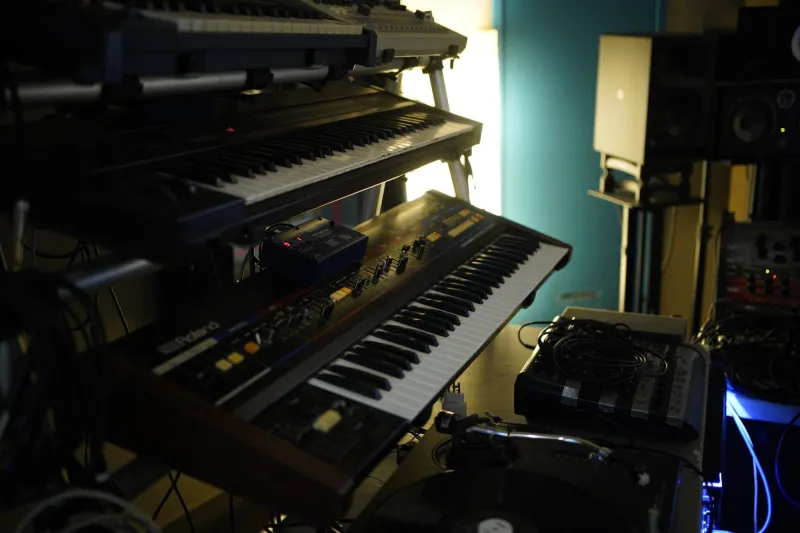
Joe Zawinul and Wayne Shorter co-founded Weather Report in 1970 after their shared tenure in Miles Davis's late-1960s electric band, and from the outset they represented fundamentally different creative temperaments. Zawinul was, by virtually every account, a maximalist and an organizer. He thought in textures, in densities, in the total sonic environment of a recording. He was drawn to the synthesizer not merely as a timbre but as a compositional tool capable of commanding an entire musical space. His instinct was to fill, to layer, to construct.
Shorter operated from the opposite principle. A saxophonist and composer of rare harmonic subtlety, he had spent years developing a musical language built on implication rather than declaration, on the suggestive phrase rather than the completed statement. His compositions — even those that eventually appeared on Weather Report albums — tended to resist resolution, preferring to hover in a kind of productive ambiguity. Where Zawinul built walls, Shorter opened windows.
These were not merely stylistic differences. They were philosophical ones, and they produced real friction in the studio and in rehearsal. Archival accounts and interviews conducted over the years with band members and close associates consistently describe a dynamic in which Zawinul increasingly assumed the role of musical director — controlling arrangements, directing sessions, and making final decisions about what appeared on record — while Shorter occupied a position that was simultaneously central and peripheral. He was the band's most celebrated soloist and one of its most gifted composers, yet his contributions were often filtered through Zawinul's architectural sensibility before reaching the listener.
The Tension on Tape
The evidence of that tension is audible if you know where to listen. Consider the contrast between Shorter's contributions to albums like Mysterious Traveller (1974) and Tale Spinnin' (1975) and the increasingly Zawinul-dominated sonic environment that surrounded them. Shorter's compositions carried a delicate, almost fragile interior logic — melodic lines that seemed to think out loud, harmonic movements that refused easy categorization. Zawinul's arrangements, by contrast, were dense and declarative, built for impact.
When those two sensibilities collided productively, the results were extraordinary. "Cucumber Slick," "Freezing Fire," and "Lusitanos" represent moments where the band's internal argument appears to have reached a kind of creative equilibrium — pieces that feel simultaneously massive and intimate, structured and free. These were not accidents. They were the byproduct of two strong-willed artists refusing to fully surrender their vision to the other's.
Musicians who passed through the band's rotating roster have described the studio atmosphere as intense and occasionally combative. Percussionists, bassists, and drummers who cycled through the group — a deliberate policy that Zawinul and Shorter maintained throughout the band's existence — often found themselves navigating not just complex musical demands but the underlying gravitational pull of two competing creative centers. That pull, paradoxically, seems to have elevated their performances. Playing between two such forceful personalities required a level of musical alertness and adaptability that more comfortable environments rarely demand.
Zawinul's Dominion and Its Discontents
By the mid-1970s, Zawinul's control over the band's direction had become pronounced enough that several observers — and, by his own later admission, Shorter himself — noted a growing imbalance. Zawinul's embrace of the synthesizer was total and evangelical. He heard the instrument as the logical extension of everything the piano had ever been in jazz, and he pursued its possibilities with the kind of single-minded focus that leaves little room for dissent.
Shorter's response was not confrontation in the conventional sense. He did not argue loudly or threaten to leave. Instead, he retreated into a kind of watchful restraint, a quality that became — somewhat ironically — one of the most distinctive features of Weather Report's sound. His saxophone lines grew more elliptical, more carefully placed within the dense sonic environments Zawinul constructed. He played less, but what he played carried more weight precisely because it arrived against such a thick backdrop of synthesized texture.
This dynamic reached its most commercially successful expression on Heavy Weather (1977), where Shorter's soprano saxophone on tracks like "A Remark You Made" sounds almost like a voice speaking privately within a crowded room — intimate, searching, and unmistakably his own. The album's enormous success owed something to both men: Zawinul's instinct for infectious groove and sonic spectacle, Shorter's capacity for melodic depth. Their disagreements, sublimated into the music itself, became the album's hidden architecture.
What Conflict Teaches
The broader lesson that Weather Report's internal dynamics offers to students of jazz and fusion is not simply that conflict can be productive — a truism that requires little argument. It is something more specific: that the most generative creative tension is the kind sustained between two people who respect each other's abilities enough to resist easy compromise.
Zawinul and Shorter never resolved their differences. They never arrived at a settled arrangement of roles that satisfied both parties completely. But they sustained the band for fifteen years and produced a body of work that continues to reward close listening decades after their final recording. That endurance was not despite their friction. It was, in substantial measure, because of it.
American popular culture tends to celebrate creative partnerships in terms of complementarity — the idea that two people succeed together because they fit neatly together, each supplying what the other lacks. Weather Report suggests a more demanding model: that the most lasting work sometimes emerges from two artists who do not fit neatly together at all, who compete for the same creative space, and who are each too committed to their vision to step aside. The music that survives such an arrangement carries the marks of that struggle. In Weather Report's case, those marks are what make it worth returning to.
The Unresolved Chord
Weather Report disbanded in 1986, and neither Zawinul nor Shorter ever fully revisited the partnership in the years that followed. Zawinul spoke candidly in later interviews about the difficulties of working alongside Shorter's particular brand of creative self-containment. Shorter, characteristically, was more oblique on the subject. What both men acknowledged, in their different ways, was that the band had been something neither could have produced alone — that the music required the resistance each offered the other.
For listeners returning to the catalog now, that knowledge transforms the listening experience. The tension is there in the recordings, encoded in the space between Shorter's saxophone and Zawinul's synthesizers, in the moments where the music seems to pull against itself before resolving into something unexpectedly beautiful. It is the sound of two extraordinary musicians refusing to agree — and, in refusing, creating something neither could have imagined alone.