Borrowed Frequencies: How Weather Report's Sonic DNA Became a Secret Weapon in Hip-Hop and R&B
There is a particular kind of producer credit that appears in the footnotes of popular music history—the one that reads simply "interpolates" or "contains elements of"—and more often than one might expect, that credit leads back to a record made by five musicians in a Miami or New York studio sometime between 1971 and 1986. Weather Report never charted on Billboard's Hot 100. They did not write songs for radio. And yet the sonic infrastructure they built over fifteen years of relentless experimentation has become one of the most quietly sampled and silently imitated catalogs in contemporary popular music.
The story of how this happened is not straightforward. It does not follow the familiar arc of a jazz record being lifted wholesale by a hip-hop producer looking for a two-bar loop. The Weather Report influence is more architectural than that—more concerned with texture, with the relationship between synthesizer and rhythm, with the way a groove can be simultaneously propulsive and suspended. Understanding it requires tracing several distinct lineages that developed more or less independently across decades.
The Crate-Digging Years
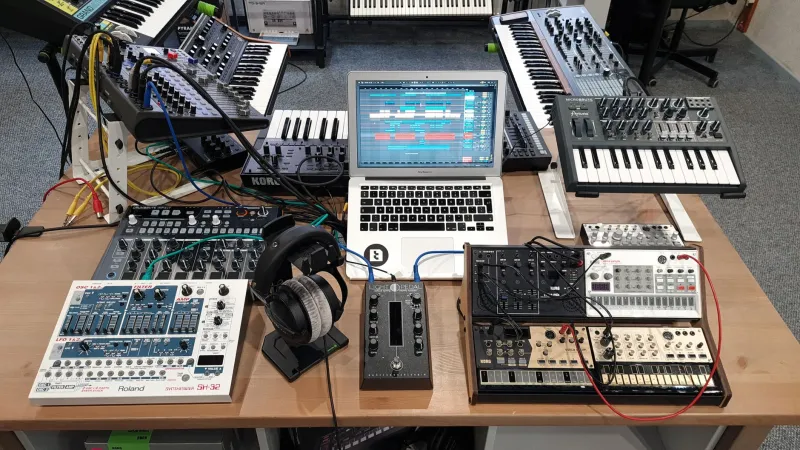
The earliest and most direct pathway runs through the sampling culture of the mid-1980s and early 1990s, when producers in New York and Los Angeles were systematically mining jazz-fusion records for rhythmic material. Weather Report's catalog was particularly attractive for reasons that had everything to do with Joe Zawinul's synthesizer work. The ARP 2600, the Oberheim, the Prophet-5—the instruments Zawinul deployed across albums like Mysterious Traveller, Tale Spinnin', and Black Market produced tones that were simultaneously warm and unfamiliar, organic and synthetic. They sat in a frequency range that, when isolated and looped, created the kind of harmonic density that early hip-hop producers were seeking as an alternative to the more commonly sampled soul and funk records.
"Birdland," the opening track from Heavy Weather, became the most frequently sampled single piece in the catalog, though its influence extends well beyond direct sampling. The melody's structure—built on a kind of jubilant, ascending phrase that Zawinul reportedly conceived after hearing a description of the original Birdland club—has been interpolated, referenced, and reconstructed so many times across R&B production that it has effectively become a shared vocabulary. Producers who have never consciously studied the track have absorbed its intervallic logic through the work of those who came before them.
Jaco's Groove and the Architecture of the Low End
If Zawinul's synthesizers provided the harmonic raw material, Jaco Pastorius's bass work supplied the rhythmic vocabulary that contemporary producers have found equally generative. Pastorius did not play bass lines in any conventional sense. He played countermelodies that happened to occupy the low end of the frequency spectrum, and the interaction between those lines and the percussion—whether supplied by Alphonse Mouzon, Alex Acuña, Peter Erskine, or any of the other remarkable drummers who cycled through the band—created a polyrhythmic density that anticipated what producers would later attempt to construct through layering and programming.
The groove architecture on tracks like "Teen Town" and "A Remark You Made" has been studied and reconstructed by producers working in neo-soul and contemporary R&B, who recognize in Pastorius's approach a model for how bass and rhythm can interact without either element dominating. Modern artists operating in the space between jazz, soul, and hip-hop—a space that has become increasingly populated over the past decade—frequently cite this aspect of Weather Report's work as a structural reference point rather than a stylistic one. They are not trying to sound like Weather Report; they are trying to solve the same compositional problems that Weather Report solved, and they are reaching for the same tools.
Electronic Textures and the Contemporary Beat
The third and perhaps most diffuse lineage runs through the electronic production community, where Zawinul's synthesizer explorations have achieved a kind of canonical status that their original jazz-fusion context might not have predicted. Producers working in ambient R&B, lo-fi hip-hop, and what has come to be called "future beats" frequently describe Weather Report's mid-period albums—Mysterious Traveller, Sweetnighter, Tale Spinnin'—as reference points for the relationship between electronic texture and acoustic space.
What these producers are responding to is something specific about the way Zawinul integrated his synthesizers into the ensemble. He did not treat them as lead instruments in the conventional sense, nor did he use them purely for textural support. They occupied a middle ground, contributing to the harmonic and rhythmic fabric of the music without asserting a dominant presence. This approach—which was genuinely radical in the early 1970s and remains relatively uncommon today—maps surprisingly well onto the layering techniques that contemporary producers use in digital audio workstations.
The Vocabulary Nobody Credited
What makes this story particularly interesting, from a critical standpoint, is the degree to which the Weather Report influence has operated beneath the level of conscious attribution. Unlike, say, the influence of Miles Davis's Bitches Brew—which has been extensively documented and freely acknowledged by producers across genres—the Weather Report contribution to contemporary popular music has largely gone unnamed. This is partly a function of the band's relatively low profile outside of jazz circles, and partly a function of the indirect nature of the influence itself. When a producer builds a beat that draws on polyrhythmic complexity and synthesizer texture, they may be reaching back to Weather Report through three or four intermediate steps without recognizing the original source.
That invisibility is, in its own way, a testament to the depth of the influence. The most thoroughly absorbed musical lessons are the ones that no longer require attribution because they have become part of the shared language. Weather Report's melodic innovations, groove architecture, and electronic textures have achieved precisely that status in hip-hop and R&B production—not as a celebrated reference point, but as an unmarked foundation. The frequencies were borrowed so long ago, and so completely, that they now feel original.
For those willing to trace the lineage, the evidence is everywhere. It lives in the synthesizer pads underneath a contemporary R&B ballad, in the bass-and-drum interplay of a neo-soul groove, in the harmonic complexity that separates sophisticated hip-hop production from its more formulaic counterparts. Weather Report did not make popular music. But popular music, in ways it has rarely acknowledged, made itself partly out of Weather Report.