Coded in Sound: How Zawinul's Machines Foretold the Age of Algorithmic Music
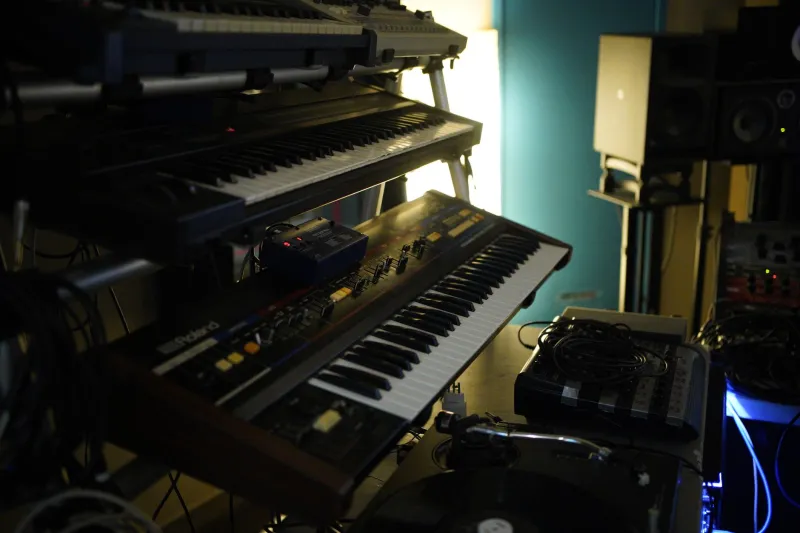
There is a particular kind of prophecy that goes unrecognized precisely because it arrives too early. The prophet speaks in a language the present cannot yet decode, and so the message sits dormant, waiting for circumstances to catch up. When Joe Zawinul strapped on his ARP 2600 in the early 1970s and began coaxing sounds from it that no human hand had previously produced, he was not simply expanding a sonic palette. He was, whether he fully understood it or not, posing a question that would take fifty years to become urgent: when a machine participates in the creation of music, where does authorship reside?
That question now dominates every serious conversation about artificial intelligence and creative practice. Yet Weather Report was already living inside it, uncomfortably and productively, while Richard Nixon was still in the White House.
The Machine as Collaborator, Not Tool
Most musicians of the early fusion era treated synthesizers as sophisticated substitutes — electronic organs, ersatz strings, novel textures to be layered beneath conventional improvisation. Zawinul refused that framework almost immediately. What distinguished his approach was an insistence on treating the synthesizer as an entity with its own behavioral tendencies, its own resistances, its own capacity to surprise. He spoke repeatedly in interviews about sounds that seemed to emerge from the instrument unbidden, directions he had not planned but chose to follow.
This is not mysticism. It is a precise description of what contemporary AI researchers call emergent behavior — outputs that arise from a system's internal logic rather than from explicit programmer intent. Zawinul was, in practice, operating a rudimentary generative system and making artistic decisions about which emergent results warranted preservation. The workflow he described — provoke, listen, respond, redirect — is structurally identical to the human-AI creative loop that musicians today are navigating with tools like Stable Audio and Suno.
The difference, of course, is one of scale and autonomy. But the underlying philosophical problem is the same: how much creative credit belongs to the human who sets the parameters, and how much to the system that generates the result?
Sequencers and the Grammar of Repetition
Weather Report's use of sequencer patterns on albums like Mysterious Traveller and Tale Spinnin' introduced another dimension of this conversation. A sequencer, at its core, is a machine that executes a pre-programmed rhythmic or melodic loop without deviation. The human sets the pattern; the machine runs it indefinitely, indifferently, without fatigue or interpretation.
What Zawinul understood — and what made Weather Report's sequencer work so philosophically rich — was that placing a human improviser against a machine loop creates a productive tension that neither party could generate alone. Wayne Shorter's saxophone lines, floating above sequencer-driven ostinatos, gain meaning precisely from the contrast between their organic unpredictability and the mechanical certainty beneath them. The human voice becomes more human when measured against something that cannot be human.
This insight anticipates the entire aesthetic logic of electronic dance music, hip-hop production, and contemporary AI-assisted composition. When a producer today layers a live vocalist over an algorithmically generated chord progression, they are working within a framework that Weather Report sketched out in a recording studio in Los Angeles half a century ago.
Automation and the Question of Intent
Perhaps the most striking parallel between Weather Report's practice and our current moment involves the question of intent. Critics of AI-generated music frequently argue that what machines produce cannot be art because machines have no intentions, no experiences, no stakes in the outcome. The music is technically accomplished but spiritually vacant.
Zawinul, characteristically, refused easy answers. He described his synthesizers as capable of expressing emotion — not because the machines felt anything, but because the sounds they produced, in the contexts he constructed, triggered genuine emotional responses in listeners. The locus of feeling, he seemed to suggest, was not in the instrument or even in the musician, but in the encounter between sound and listener.
This is a remarkably sophisticated position, and it maps directly onto the most nuanced current arguments about AI creativity. Philosophers like Margaret Boden and David Cope have argued for decades that computational creativity is real creativity, not because machines are conscious, but because the outputs they generate can be genuinely novel, genuinely moving, and genuinely meaningful to human audiences. Zawinul arrived at a version of this conclusion empirically, through practice, without the benefit of academic frameworks.
What the Debates Are Missing
The contemporary discourse around AI and music is frequently impoverished by its presentism — its assumption that the questions being raised are entirely new. They are not. Weather Report demonstrated, across a remarkable decade of recordings, that the boundary between human and machine creativity is not a wall but a membrane, permeable and negotiated in real time.
What the band also demonstrated, crucially, is that the negotiation is the art. Zawinul's greatest synthesizer performances are not great because the machine did something impressive or because the human overrode the machine. They are great because the relationship between the two was dynamic, responsive, and genuinely collaborative in the deepest sense of that word.
As the music industry braces for AI tools that can generate entire albums on demand, the Weather Report archive offers something more valuable than nostalgia. It offers a model — a demonstration that technology and human creativity are not adversaries but interlocutors, and that the most interesting music has always emerged from the space between what a musician intends and what a system makes possible.
The prophets, as it turns out, were not ignored so much as heard too early. The frequency was right. The receivers simply had not been built yet.