More Than a Pulse: How Weather Report's Drummers Turned Rhythm Into a Language of Its Own
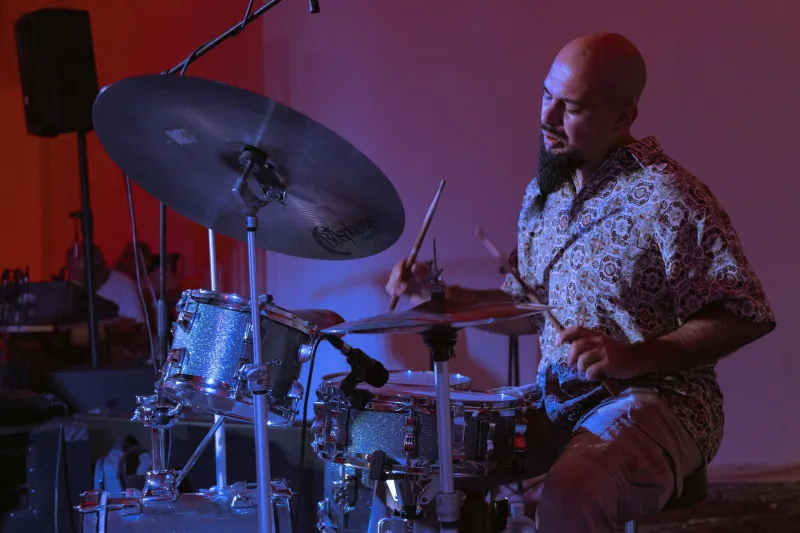
There is a temptation, when discussing Weather Report, to begin and end with the synthesizers. Joe Zawinul's keyboards commanded attention by design, and Wayne Shorter's saxophone carried the weight of an already-legendary career. But beneath those surfaces, something equally consequential was occurring. The band's percussionists — rotating through a remarkable cast of rhythmic thinkers — were quietly dismantling assumptions about what a drummer's role in jazz was permitted to be.
This is not a peripheral story. It is, in many respects, the story of how jazz fusion found its spine.
The Seat No One Could Sit Still In
Weather Report cycled through drummers at a pace that might, in another band, suggest instability. In their case, it reflected something more deliberate: a relentless search for a specific kind of rhythmic intelligence. Eric Gravatt, Ndugu Chancler, Alphonse Mouzon, Chester Thompson, Alex Acuña — each brought a distinct vocabulary to the kit. Each was asked not merely to provide a foundation but to participate in the band's collective improvisation as a full and equal voice.
Zawinul was famously exacting about rhythm. He had absorbed Afro-Cuban, Brazilian, and West African traditions long before those influences were fashionable in American jazz circles, and he expected his drummers to speak those languages fluently. The result was a percussive approach that owed as much to global folk traditions as it did to bebop or rock — a synthesis that, at the time, had almost no precedent in a jazz context.
Chester Thompson and the Architecture of 'Mysterious Traveller'
Chester Thompson joined Weather Report in time to appear on Mysterious Traveller (1974), and his contribution to that record remains one of the most underappreciated performances in the fusion canon. Thompson, who would later become widely known for his work with Genesis and Frank Zappa, brought a technical precision to Weather Report's rhythmic concept that was matched by genuine musical curiosity.
On tracks such as "Scarlet Woman," Thompson navigates time signatures that shift without announcement, treating the metric changes not as obstacles but as natural terrain. His snare placement in particular defies easy categorization — it neither locks rigidly to the backbeat nor abandons it entirely, instead inhabiting a middle space that feels simultaneously composed and spontaneous. This was not accidental. Thompson has spoken in interviews about the degree to which Zawinul encouraged the drummers to think melodically, to consider the drum kit as a pitched instrument capable of carrying harmonic implications through tone and resonance rather than pitch alone.
What Thompson demonstrated on Mysterious Traveller was that polyrhythm need not be a display of technical bravado. Deployed with restraint, it could create texture — a kind of rhythmic counterpoint that made the entire band sound larger and more dimensional than its actual headcount.
Alex Acuña and the Afro-Cuban Transformation
If Thompson brought structural sophistication to the drum chair, Alex Acuña brought fire. The Peruvian-born percussionist joined Weather Report ahead of the Heavy Weather sessions in 1977, and his influence on that album — the band's commercial peak — is difficult to overstate.
Acuña's background in Afro-Cuban and Latin percussion gave Weather Report a rhythmic density that their earlier records had approached but never fully inhabited. His work on "Birdland" is the obvious reference point, and for good reason: that track's opening percussion figure is one of the most recognizable rhythmic statements in jazz fusion history. But to focus exclusively on "Birdland" is to miss the subtler contributions Acuña made throughout the album.
On "Teen Town" — Jaco Pastorius's showcase piece — Acuña locks into a groove with Pastorius that operates on multiple rhythmic levels simultaneously. The kick drum pattern suggests one meter while the hi-hat implies another, and the interplay between the two creates a sensation of forward momentum that is almost physical in its intensity. This was not merely accompaniment; it was co-composition in real time.
Acuña has described his approach during this period as an effort to bring the drum kit and the congas into genuine dialogue, treating them as a unified instrument rather than two separate tools. The result was a percussive language that was identifiably Latin in its roots but entirely original in its application — a synthesis that reflected Weather Report's broader project of dissolving the boundaries between musical traditions.
Electronic Percussion and the Road Forward
What is perhaps most striking, in retrospect, is how prescient Weather Report's rhythmic approach turned out to be. The band began incorporating electronic percussion elements in the late 1970s, a period when drum machines were still largely novelties rather than serious musical tools. Zawinul's interest in texture extended naturally to electronic rhythm — he recognized that the synthesizer and the drum machine were, at their core, solving the same problem: how to expand the sonic palette beyond what acoustic instruments alone could provide.
The rhythmic programming sensibility that Weather Report developed during this period — the layering of acoustic and electronic elements, the use of syncopation to create tension against a steady pulse, the willingness to let silence function as a rhythmic event — became foundational to the drum programming practices that would define electronic dance music, hip-hop production, and contemporary R&B in the decades that followed. Producers working in those genres may not cite Weather Report as a direct influence, but the structural logic they employ traces a clear line back to the experiments Zawinul, Acuña, and Thompson were conducting in the mid-1970s.
Rhythm as Argument
The deeper contribution of Weather Report's percussionists was philosophical as much as technical. They demonstrated, through sustained practice across hundreds of recordings and live performances, that rhythm in jazz need not be subordinate to melody and harmony. The drum kit was not a clock; it was a voice. It could assert, contradict, question, and resolve. It could carry the emotional weight of a composition as fully as any horn or keyboard.
This was a radical proposition in 1974. It is easy to forget how radical, because the argument has since been largely won. Contemporary jazz, electronic music, and even mainstream pop production now take for granted the idea that rhythm is a compositional element rather than a support structure. Weather Report's percussionists — working in relative obscurity compared to the band's more celebrated soloists — were among the primary architects of that shift.
The next time you encounter a drum pattern that seems to breathe, that seems to think, that seems to be saying something rather than simply marking time, consider the lineage. There is a very good chance it leads, through a chain of influences both acknowledged and forgotten, back to a studio in the mid-1970s where Alex Acuña or Chester Thompson was doing something that nobody had quite done before — and that nobody who heard it could entirely forget.